Rewards and loyalty for restaurants and cafés give guests a clear reason to return. With Yournotify, connect an understandable earning rule, a useful benefit and a reliable redemption process that both guests and staff can explain.
This guide helps restaurant and café owners design that programme with Yournotify Loyalty, Rewards and Referrals. It covers the guest journey, sample rules, communication, transaction handling and the calculations needed to judge whether an incentive is useful for the business.
Table of Contents
Plan loyalty for restaurants around one guest behaviour
Start with one behaviour: a repeat visit, an eligible purchase, a qualifying referral or participation in a particular programme. Do not reward every action at once. A complicated launch makes it harder to spot mistakes and harder for guests to understand the benefit.
| Business situation | Useful objective | Possible programme design |
|---|---|---|
| Café with regular local guests | Encourage a repeat eligible purchase | A simple points or visit-based benefit supported by recorded events |
| Restaurant with several branches | Recognise eligible guests consistently | A shared rule with clear branch participation |
| New menu or service | Invite relevant guests to try it | A targeted reward with explicit eligibility |
| Catering or group bookings | Encourage appropriate referrals | Reward a confirmed qualifying referral, not merely a shared link |
The design must fit how you record sales. A programme that relies on a visit being counted needs a reliable visit event. If the store only records purchases, begin with an earning rule that uses that evidence.
What Starbucks demonstrates
Starbucks’ 2026 US Rewards announcement describes membership levels, earning progress and differentiated benefits. The useful lesson is to make progress and eligibility visible to the member.
A Nigerian restaurant can apply that principle without copying a large international programme. Start with one earning rule, one attainable benefit and a clear way to see or receive confirmation of progress. Add tiers only when the data and staff process can support them.
Write the programme rules before configuring it
Record who can join, which purchases qualify, how points are earned, what the benefit costs, when it can be redeemed and how returns or cancellations affect the balance. Use ordinary language and show examples.
Here is an illustrative points design:
- Earn one point for every ₦100 of eligible spend.
- Redeem 100 points for a specified benefit with a ₦500 face value.
- Define excluded purchases and participating branches explicitly.
- Record confirmed purchases once and reverse points when the underlying qualifying transaction is reversed under your rules.
Under that example, ₦10,000 of eligible spend earns 100 points. A ₦4,000 qualifying order earns 40 points. The ₦500 face-value benefit represents 5% of the earning threshold, but its actual business cost depends on what is provided. These are design examples, not Yournotify default rules or recommended universal rates.
Understand the reward budget
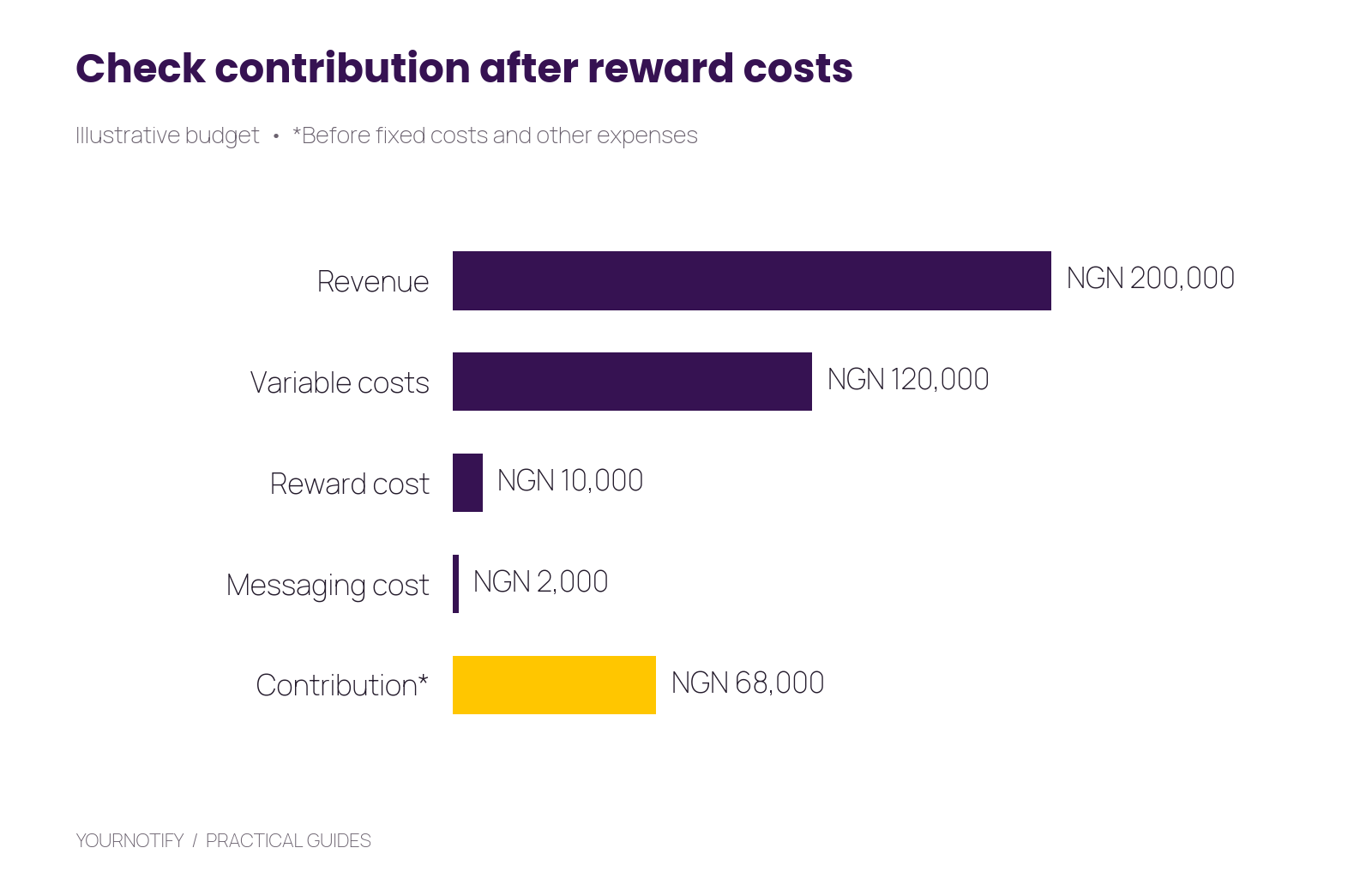
Illustrative budget: ₦200,000 revenue minus ₦120,000 variable costs, ₦10,000 reward cost and ₦2,000 messaging cost leaves ₦68,000 contribution before fixed costs and other expenses. These are sample figures, not results from a real campaign.
This calculation prevents an attractive redemption count from being mistaken for profit. Use your actual reward fulfilment cost, food or beverage cost, delivery costs where relevant and campaign charges. A benefit’s face value and its cost to the business are not necessarily identical.
To assess whether the programme creates additional value, compare suitable cohorts or test groups. Existing loyal guests may have returned without the reward; a redemption alone does not prove an incremental visit.
Step 1: create a clear member journey
Let guests understand what they are joining and how their contact information will be used. Keep the signup form short and provide a practical route for staff to help someone who cannot complete it immediately.
Create or identify the contact once, then connect that identity with the qualifying activity. Decide how a guest will be recognised at purchase: your supported checkout integration, account identification or an agreed staff process. Avoid using a new contact record for every order.
Use Yournotify contact management for organised member data, and keep communication preferences available for promotional messages.
Step 2: configure Loyalty and the redeemable reward
In Yournotify Loyalty, create the programme and configure the supported earning rules, membership and relevant settings. Prepare an active reward in Rewards and connect it to the points cost where the programme uses points redemption.
The current Yournotify documentation describes loyalty programmes, points entries, reward mappings and redemption. Follow the actual fields in the account rather than treating the illustrative rule above as a ready-made system preset.
Distinguish a reserved reward from a completed claim or fulfilment. Your staff and customer messages should reflect the actual stage. A message saying “Your reward is available to claim” is different from saying it has already been delivered.
Test with a dedicated member before announcing the programme publicly.
Step 3: connect qualifying purchases and corrections
Send confirmed activity from the system that owns it. Use a stable transaction reference and ensure a retry does not award points twice. Keep the contact identity, qualifying amount or event and programme rule consistent.
Test a normal purchase, a repeated event, an ineligible purchase and the correction process for a cancelled transaction. Staff should know how to investigate a balance without casually changing it to make a complaint disappear.
For multiple branches, agree whether earning and redemption are shared and ensure the implementation supports that promise. Display the same customer-facing rules at each participating branch.
Step 4: prepare messages guests can understand
Welcome
Welcome to Example Café Rewards. View how to earn and claim your benefits here: https://example.com/rewards. Ask our team if you need help connecting your next eligible purchase.
Progress update
Your eligible purchase has added 40 points. Your current balance and available benefits are shown in your member account.
Reward available
You have reached the points needed for your selected benefit. Review the claim details and participating locations before redeeming.
Relevant return invitation
Planning another visit? Your available reward and its conditions are shown here: https://example.com/member. Choose a time and location that suit you.
Use the actual confirmed balance or claim state. Do not include an expiry date or “last chance” claim unless it matches the programme’s real conditions. Choose email, SMS or the appropriate WhatsApp template according to the purpose and guest’s preferences.
Step 5: add referrals with a clear qualifying event
Once the loyalty process works, Yournotify Referrals can support a structured referral programme. Define what qualifies, who receives the benefit, any limits and what happens if the qualifying transaction is cancelled.
For example, the referring guest could become eligible after a new guest completes a qualifying first purchase. Sharing a link or submitting a form should not be treated as a completed purchase. Connect the verified event before issuing the relevant benefit.
Keep self-referrals, duplicate events and repeated claims in your test plan. Explain the programme in plain language so guests understand what must happen and staff can resolve questions consistently.
Step 6: review the programme weekly
Track eligible members, qualifying activity, points issued, rewards reserved, claims fulfilled and repeat purchases within a defined period. Reconcile totals with the underlying transaction records.
| Measure | Why it matters | Useful review question |
|---|---|---|
| Activation | Shows whether new members participate | Did the first eligible purchase connect correctly? |
| Reward claim rate | Shows whether the benefit is usable | Is the claim process clear? |
| Repeat purchase | Shows whether members return | Is the comparison period consistent? |
| Fulfilment failures | Reveals operational friction | Who owns the unresolved claim? |
| Contribution after costs | Tests commercial usefulness | Does the benefit fit the actual margin? |
Use the referral and loyalty calculator as a planning aid where appropriate, then reconcile with actual programme and sales data. Keep assumptions visible rather than presenting a forecast as an achieved result.
Frequently asked questions
Should we offer a discount or a reward?
Choose the benefit that suits the guest and the economics. Compare actual cost, usability and the behaviour you want to encourage rather than judging only face value.
Can we use airtime or data as a reward?
Explore the options supported by Yournotify Rewards and define the eligible activity and fulfilment process. Match the benefit to your audience rather than assuming every guest wants the same thing.
Do we need several loyalty tiers?
No. One clear rule and a reliable claim process are a strong starting point. Add complexity only when it helps guests and the team can manage it.
Can staff award points manually?
Use the authorised programme process and record the reason and transaction reference. Manual corrections should be traceable and consistent with the programme rules.
Launch a programme your team can operate
Start with Yournotify Loyalty, one defined earning rule and one well-tested benefit. Pilot with a manageable group, reconcile the results and improve the guest experience before expanding.